See how impact capital flows across 10,000+ funders and companies → Explore the Ecosystem Map

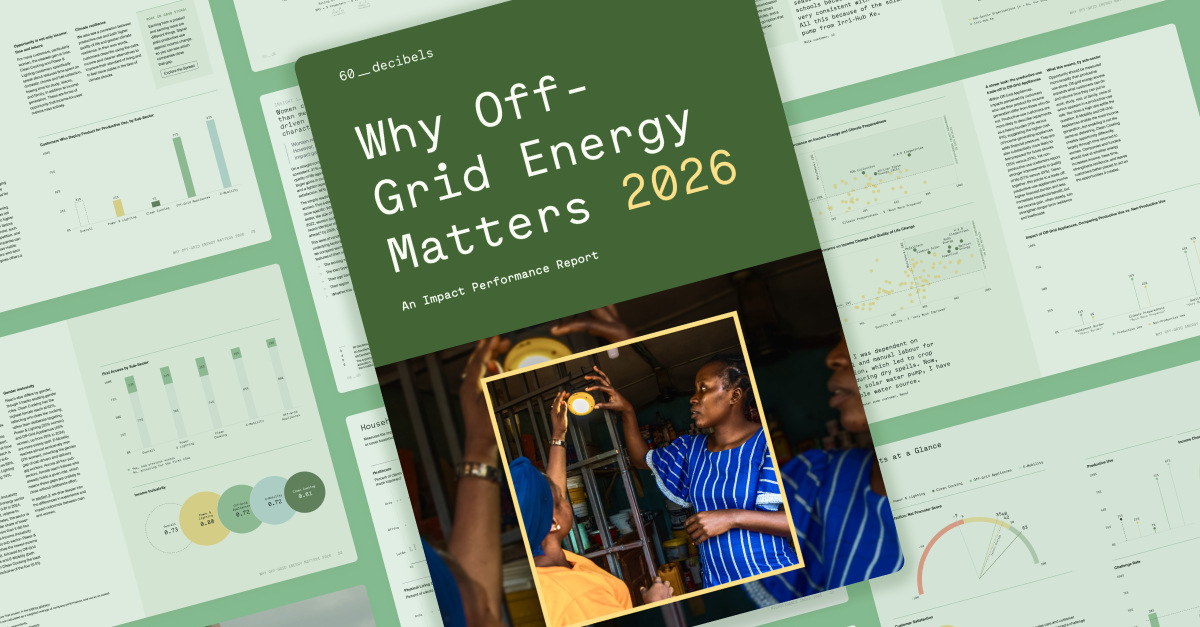
Why Off-Grid Energy Matters 2026

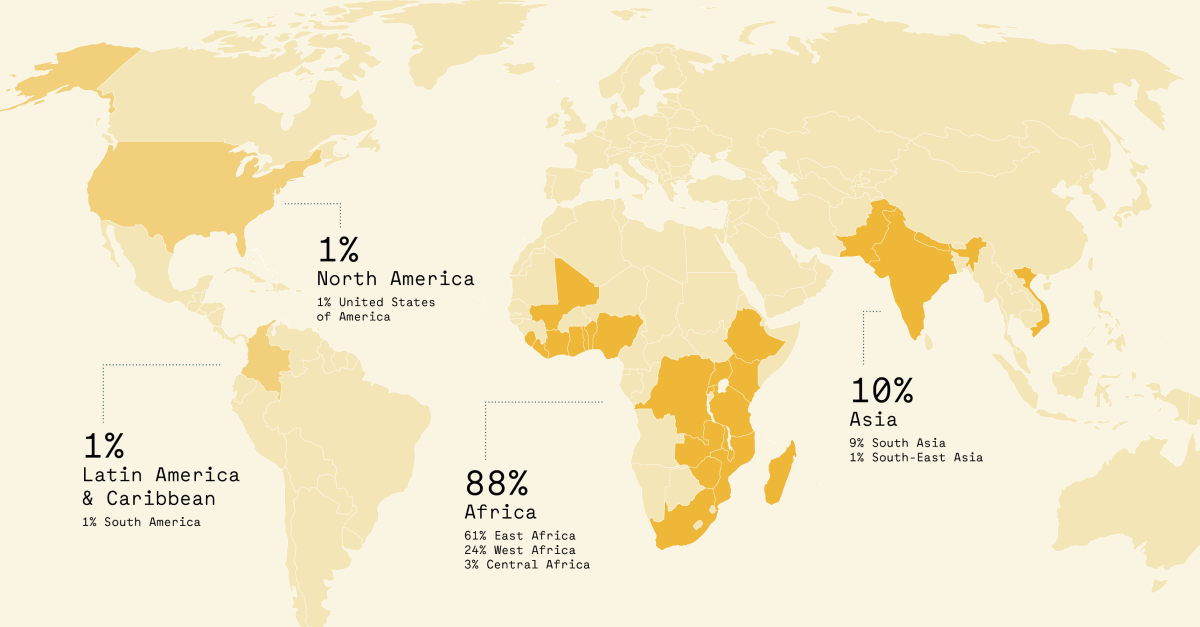
Our report built on interviews with 28,000+ energy customers from 30 countries, with the headline question: what actually turns energy access into impact?

Welcome to the 2026 edition of Why Off-Grid Energy Matters

It has been six years since we published our first instalment and brought you insights from the world’s largest body of customer feedback about the impact of off-grid energy.

With just a few years remaining to achieve SDG 7 (ensuring access to affordable, reliable, sustainable and modern energy for all by 2030), the need for evidence on what works has never been greater. This report contributes to that evidence base by bringing together the experiences of more than 140,000 customers, highlighting both where the sector is delivering meaningful impact and where further progress is needed to deepen and sustain it. 

Download the full report
Why Off-Grid Energy Matters 2026

These findings are based on our 2026 dataset of 28,000+ customer interviews. They build on our previous reports: Why Off-Grid Energy Matters 2020 (34,000+ interviews) and Why Off-Grid Energy Matters 2024 (79,000+ interviews).

Register your spot for our launch webinar on Oct 6th.

“When we entered the house, we connected to solar immediately and the whole place was lit. It’s even more affordable than the normal electricity. I fear candles for the fire accidents that it can cause, I’m very safe with solar.”

Female, Solar home system customer, Uganda

“My agriculture business has improved. I save the money which was used to purchase fuels like petrol and diesel. With the help of the money earned, my quality of life was improved.”

Male, Solar water pump customer, Nepal

“I can charge my phone, and we can also charge the radio for entertainment, allowing the children to study at night. ”

Female, Solar home system customer, Zambia

“Because of the solar water pump, most of the land is irrigated and used to grow different crops and get good profit. We’re living a good life by earning great income.”

Male, Solar water pump customer, Nepal

“I don’t have stress cooking; I spend less time cooking, and I also save money from buying charcoal. I am healthier now because I don’t inhale smoke from charcoal that used to make me fall sick all the time.”

Female, Cookstove customer, Nigeria

28,000+

Off-grid energy customers

30+

Countries

90

Energy companies
Join our Oct 6th launch session
Register your spot

2026 Headlines

  • Ease of use drives whether access becomes impact

    Customers who report a challenge with their product or service also report significantly lower impact across quality of life, safety, health and energy spending, regardless of sub-sector. Our first two editions show that customer experience shapes impact. The 2026 data go further: access on its own does not create impact, and whether it does depends on ease of use. Funders should ask investees for challenge and resolution rates alongside sales numbers, and treat them as an impact risk, not only an operational one.

  • E-Mobility has untapped potential for impact, particularly income change, and is currently blocked by poor ease of use

    E-Mobility, as a sub-sector, has high productive use (a product that can unlock income generation), but masks weak product experience and shallow depth of impact. The sub-sector has an average Net Promoter Score of -7, a challenge rate of 61%, and only 15% of customers report any significant gains in income. This is the clearest example in our data of how customer experience influences impact. Productive use products that are unreliable create limited impact — and have real potential for improvement. Investors in this sector would be wise to ensure that use of funds is allocated not just to growth objectives, but also to shaping product experience. Resources for reliability, servicing networks, and battery and charging infrastructure will do more for impact than a number of new units sold without that infrastructure in place.

  • Even as part of a ‘portfolio of fuels’, clean cookstoves deliver outsized impact. Clean Cooking works differently to the other sub-sectors: it complements rather than replaces

    Compared with roughly half or more of customers in other sub-sectors, only around a quarter of Clean Cooking customers stop using their prior fuels. Yet one in two customers report significant improvements in safety, quality of life, and health. The sector also records the highest Net Promoter Score (63) and the lowest challenge rate (23%). This nuances our 2024 finding that small products drive big outcomes: even partial shifts to cleaner fuels deliver them. For many households, clean fuels complement rather than replace other fuels, with choices shaped by fuel availability and affordability. Measuring Clean Cooking on fuel replacement alone understates its value and undervalues the health, safety, and quality of life benefits, especially for women, who report the largest gains.

  • Income gains remain modest

    Even in the highest productive use sub-sectors: E-Mobility (87% customers report their off-grid energy product generates income), and Off-Grid Appliances (77%), only 15% to 34% of customers report a ‘very much’ increased income. Our earlier editions found that the impact gains of productive use of energy are real but still emerging; the 2026 data confirm that there’s a persistent gap between potential and realised gains in income.

  • Productive use needs consumer protection built in

    In Off-Grid Appliances, customers who use their product for income generation are twice as likely to describe repayments as a heavy burden (11% versus 5%). The 11% is well above the 4% we saw across our 2025 Microfinance Index, a sector where repayment risk is the central consumer protection concern. This group also reports lower quality of life gains (49% versus 57%), but higher climate resilience (35% versus 23%). Where income falls short of expectations, the repayments remain. Earlier editions treated productive use as a straightforward good. Our 2026 data suggest that productive use offerings are a higher risk, higher reward proposition. The differentiator is how repayment stress is managed. These businesses need to focus on affordability assessments, flexible repayment terms, and proactive communication of contract terms.

  • Impacts on everyday wellbeing are not a lesser form of impact

    Customers describe the value of energy in everyday terms: better light, greater safety, less stress, easier household tasks and more connection with family. For many households, these outcomes matter as much as any larger gain, and deserve to be measured directly.

  • Who reaches the customer matters: inclusive, well-run companies deliver more impact

    The spread of company performance in this report is wide. On the same metrics, some companies reach far more first-time, low-income, and women customers than others in the same sub-sector and market, and convert that reach into impact. This echoes a central finding of our 2024 edition, where locally-owned and women-led enterprises stood out as impact all-stars: more inclusive, better rated, and higher impact on average. Funders can raise the impact of their portfolio by backing the inclusive, well-run organisations our benchmarks surface, and by closing the financing gap for locally-owned and women-led companies.

2026 Energy Social Impact Awards

Appliances

Irri-Hub Ke (Kenya)

Power & Lighting

NuRa Energy (South Africa)

Clean Cooking

H & B Elegantries (Nigeria)

E-Mobility

eBee (Kenya)

We’d like to give a special mention to the companies that came 2nd for their categories:

Off-Grid Appliances: Clamore Solar (Zimbabwe)
Power & Lighting: Natfort Energy (Zimbabwe)
Clean Cooking: DelAgua Group (Sierra Leone)
E-Mobility: Euler Motors Private Ltd. (India)

Explore the Energy Social Impact Awards
Find out more

Get more out of the data with 60dB Signal

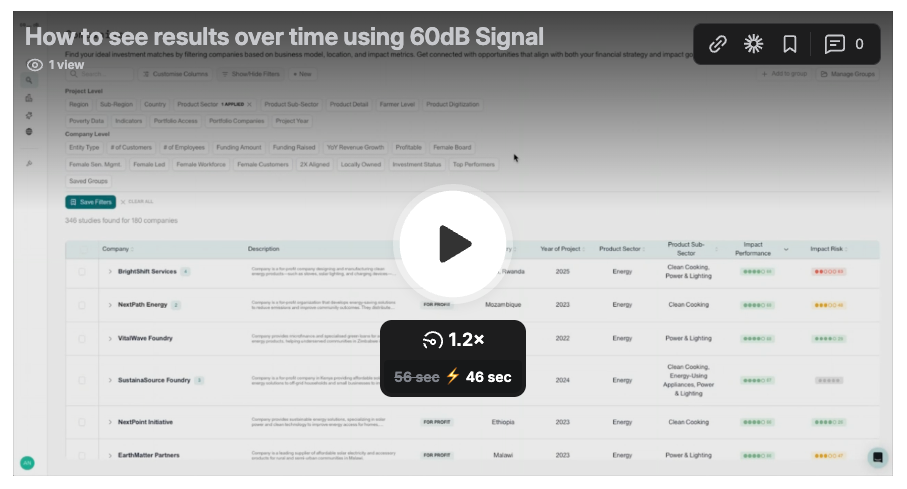
Where we have run more than one study with a company, see the direction of travel for key indicators, study by study.
See example

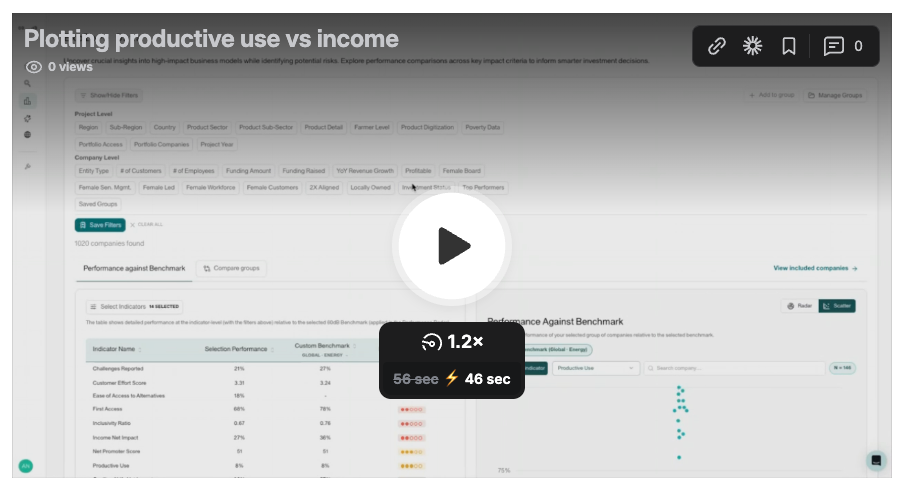
Plot productive use against income change, so you can see which companies close the gap.
See example

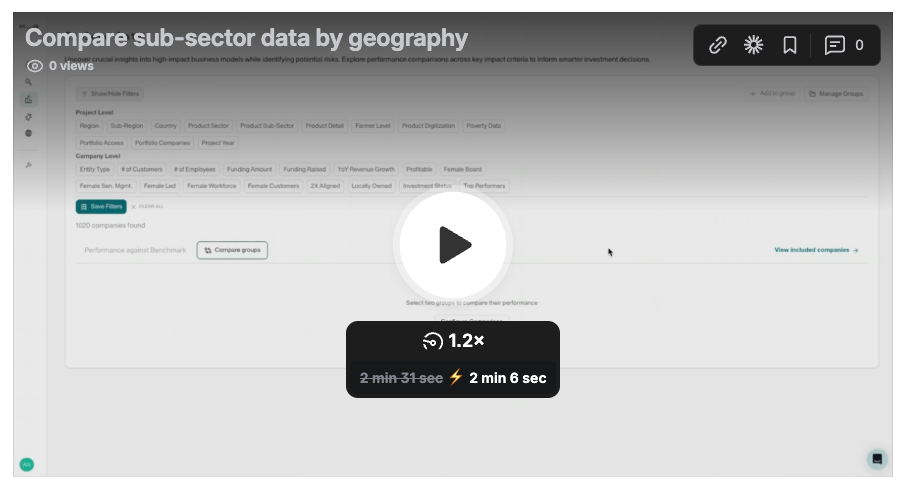
Create comparison groups to drill down indicator aggregates by sub-sector, region, country and more.
See example

Interested in taking part in 2028? Reach out to our CSO, Tom Adams
Get in touch

Latest Insights

Let's talk

Want to get in touch about an off-grid energy impact measurement project?
Get in touch

Quirky, informative, and a little bit nerdy - sign up for The Volume

Priority access to our favorite monthly finds, alongside 11,361 other data geeks

By signing up to the 60 Decibels mailing list, you consent to your data being collected and stored in line with our privacy policy