See how impact capital flows across 8,000+ funders and companies → Explore the Ecosystem Map

Powering Change: Women Entrepreneurs at the Heart of the Energy Transition

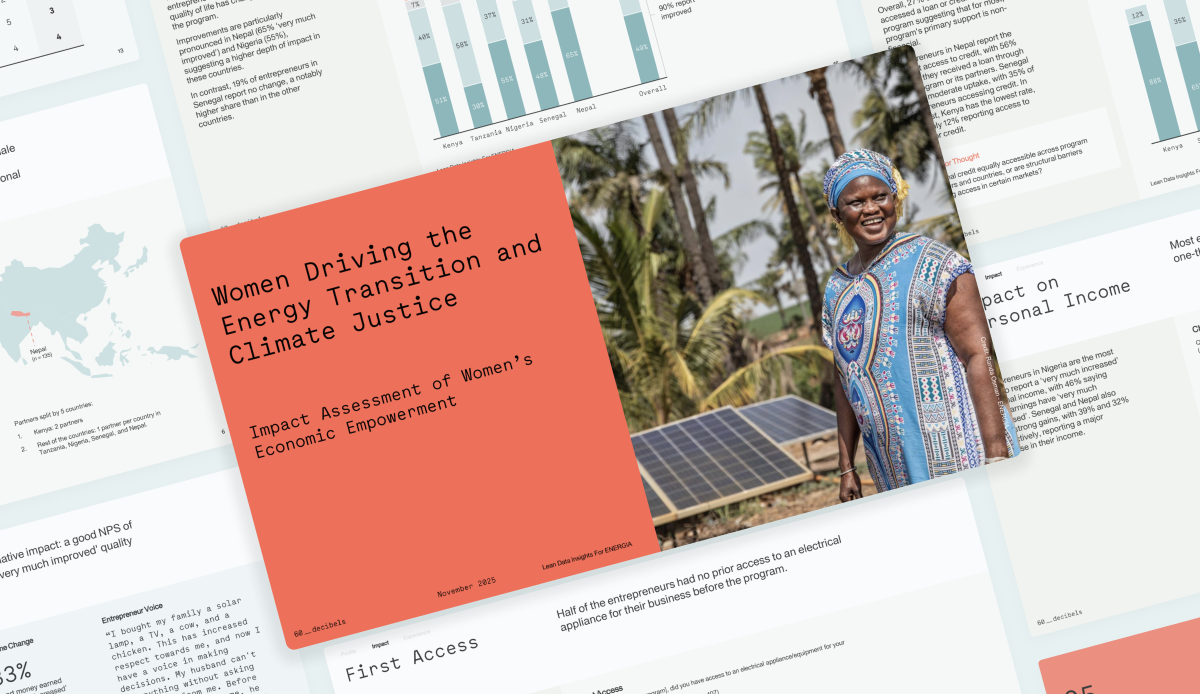
We spoke with 1,166 women entrepreneurs participating in ENERGIA’s Phase 7 Women’s Economic Empowerment Programme across Asia and Africa to understand how access to clean energy opportunities is shaping their businesses, households, and communities.

ENERGIA, the International Network on Gender and Sustainable Energy, is hosted by Hivos, an international development organisation guided by humanist values and committed to building just, inclusive and life-sustaining societies where people have equal access to opportunities, rights and resources.

ENERGIA’s Phase 7 strategy — Women Driving the Energy Transition and Climate Justice — seeks to advance universal energy access while promoting climate justice, with gender equality at its core. The strategy recognises women not only as beneficiaries of clean energy access, but as essential leaders and entrepreneurs in the energy transition.

The Women’s Economic Empowerment Programme forms a central part of Phase 7. Co-funded by the Swedish International Development Cooperation Agency (Sida) and the Asian Development Bank (ADB), the programme is delivered across five countries — Kenya, Nepal, Nigeria, Senegal and Tanzania — through partnerships with Practical Action, the Centre for Rural Technology, Mercy Corps/Energy 4 Impact, and Solar Sister.

ENERGIA and 60 Decibels

This independent impact assessment examines how ENERGIA’s Phase 7 programme has contributed to the economic and social empowerment of women entrepreneurs working in the clean energy sector.

Through direct feedback from participants, the study explores changes in women’s decision-making power, business performance, financial resilience, and social standing. It also assesses how women perceive the relevance and quality of the support delivered by ENERGIA’s partner organisations.

The findings will inform the broader external evaluation of ENERGIA’s Phase 7 strategy.

Specifically, the study focuses on three core areas:

Economic empowerment: How has ENERGIA’s support enabled women to start, grow, or strengthen their income-generating activities, improve their economic standing, and build resilience within the clean energy sector?

Social empowerment: How has participation influenced women’s roles within their households and communities, including their confidence and decision-making power?

Quality of support: How do entrepreneurs experience the programme’s support in terms of relevance, responsiveness, and overall quality?
50%

reported first time accessing electrical appliance/equipment

90%

reported improved quality of life

23%

reported challenges

Key insights

Quality of life has improved for nearly all entrepreneurs, with deeper gains in income and household well-being

Across all five countries, 90% of women entrepreneurs report improvements in their quality of life, and half report their quality of life has very much improved’ because of ENERGIA. Key drivers include higher household income (53%), business expansion (31%), and the ability to pay for children’s education (25%).

The depth of change varies across contexts: Nepal and Nigeria show the strongest improvement, while Senegal reports more modest improvements. These results highlight ENERGIA’s role in enhancing women’s livelihoods and building economic resilience which is a core Phase 7 objective.

The program drives broad, substantial economic growth

91% of entrepreneurs report higher business or farm revenues, with a third reporting increases of more than 50%. 62% say their current income-earning activity began because of ENERGIA’s support.

By enabling business creation, expansion, and diversification, the program is laying the foundation for sustainable, women-led income generation beyond the life of the intervention, directly addressing ENERGIA’s long-term economic-empowerment goal for Phase 8.

ENERGIA is strengthening women’s financial control and decision-making power

58% of entrepreneurs decide independently how to use business income, while 83% report greater ability to make key business decisions. Patterns vary across countries: Kenya and Senegal show higher individual financial autonomy, whereas Nepal reflects strong joint decision-making (84%), demonstrating empowerment through shared influence. These findings indicate that ENERGIA’s approach builds both economic autonomy and collaborative agency.

The program is fostering transformative social empowerment within households and communities

81% of entrepreneurs report increased respect and recognition, and 55% say this respect has ‘very much improved’. Women link this change to their financial contributions, improved living conditions, and greater recognition of their efforts and skills.  These shifts point to tangible social transformation where women gain not only income but also status, voice, and respect, advancing ENERGIA’s gender-equality objectives.

Entrepreneurs are highly satisfied, underscoring the quality and relevance of the program’s support

The overall Net Promoter Score (NPS) of 47 indicates strong satisfaction, and only 23% report challenges, most often related to high product prices.

 Participants most value business skills training, income-earning opportunities, and product quality. High satisfaction demonstrates ENERGIA’s relevance and effectiveness.

“I like the program because they train us properly. I now have business ideas aside from selling the solar products. If I want to sell, I know what to implement to get results.”

Alumni, Nigeria, 31

“I used the money I gained from selling [partner program] products to expand my business of cooking buns. Instead of buying 1 kilogram of flour as before, I bought a full sack of flour and a bucket of cooking oil.”

Alumni, Tanzania, 32

“I have gotten a platform to work and earn money. I’ve learnt how to interact and work with different people, stakeholders, and clients, and mastered great sales skills.”

Entrepreneur, Kenya, 59

“In order for the program to have a greater impact, [partner program] must provide us with seeds and strengthen our capacity to process vegetables.”

Entrepreneur, Senegal, 55

“If more training is added, it will be much better, which will help us and help in generating more income than now.”

Entrepreneur, Nepal, 32
Explore the full report
Download

Latest Insights

Let's talk

We help you understand your social performance by listening to your customers, suppliers, employees, or beneficiaries.
Get in touch

Quirky, informative, and a little bit nerdy - sign up for The Volume

Priority access to our favorite monthly finds, alongside 11,361 other data geeks

By signing up to the 60 Decibels mailing list, you consent to your data being collected and stored in line with our privacy policy