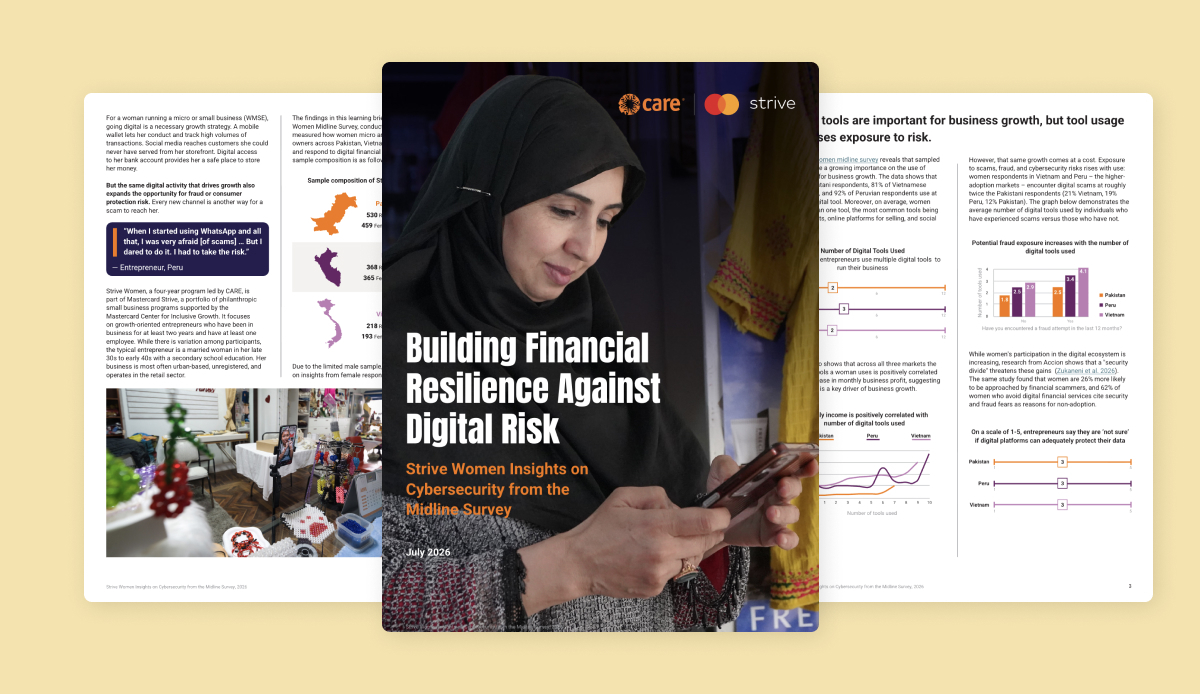
Most women we surveyed use at least one digital tool to run their business: 83% in Pakistan, 92% in Peru, and 81% in Vietnam. Across all three markets, the number of tools a woman uses is positively correlated with her monthly business profit. Exposure rises with use, though: in Vietnam and Peru, the higher-adoption markets, women encounter digital scams at roughly twice the rate of women in Pakistan (21% and 19% versus 12%).
Women recognize the importance of cybersecurity, but awareness does not always translate into action
Women rate the importance of cybersecurity for their business at 4 out of 5 across all three markets. Yet 37% of respondents in Pakistan, 31% in Vietnam, and 24% in Peru report taking no steps to protect their businesses against digital risks, and among those who do, setting strong passwords is usually the only habit. Far fewer use two-factor authentication, back up their business data, or train staff.
Women report high levels of comfort using digital tools, rating their confidence 4 out of 5. When something goes wrong, however, 47% in Pakistan, 44% in Peru, and 51% in Vietnam say they would not know what steps to take to recover a compromised account. Combined with ambivalence about whether digital platforms can protect their data, this suggests many women may not know about, or trust, the redress options available to them.
Thin financial buffers make recovery the hardest stage
A fraud event functions like any other economic shock, capable of draining savings or working capital in a single moment. Pooled across the three countries, 70% of the women we surveyed could not cover three or more months of business expenses after a shock: only 28% in Pakistan and 14% in Peru could, against 59% in Vietnam. Many have even less of a cushion, with 48% in Peru, 31% in Pakistan, and 23% in Vietnam holding under one month of reserves. For these women, a single fraud event is a significant threat to the business itself.