SAI Platform: What 402 Potato Farmers Told Us About Regenerative Agriculture
60 Decibels and SAI Platform have released a new report proposing a farmer-centred socio-economic approach to measuring regenerative agriculture, recognizing that achieving environmental outcomes relies on practices being economically viable and sustained by producers over time.
Part of a two-year initiative launched in 2025 in India by SAI Platform, McCain Foods Limited, PepsiCo, 60 Decibels, and the International Potato Center (CIP), the newly developed approach seeks to address a critical question often overlooked in sustainability programmes: how are farmers themselves experiencing the transition to regenerative agriculture?
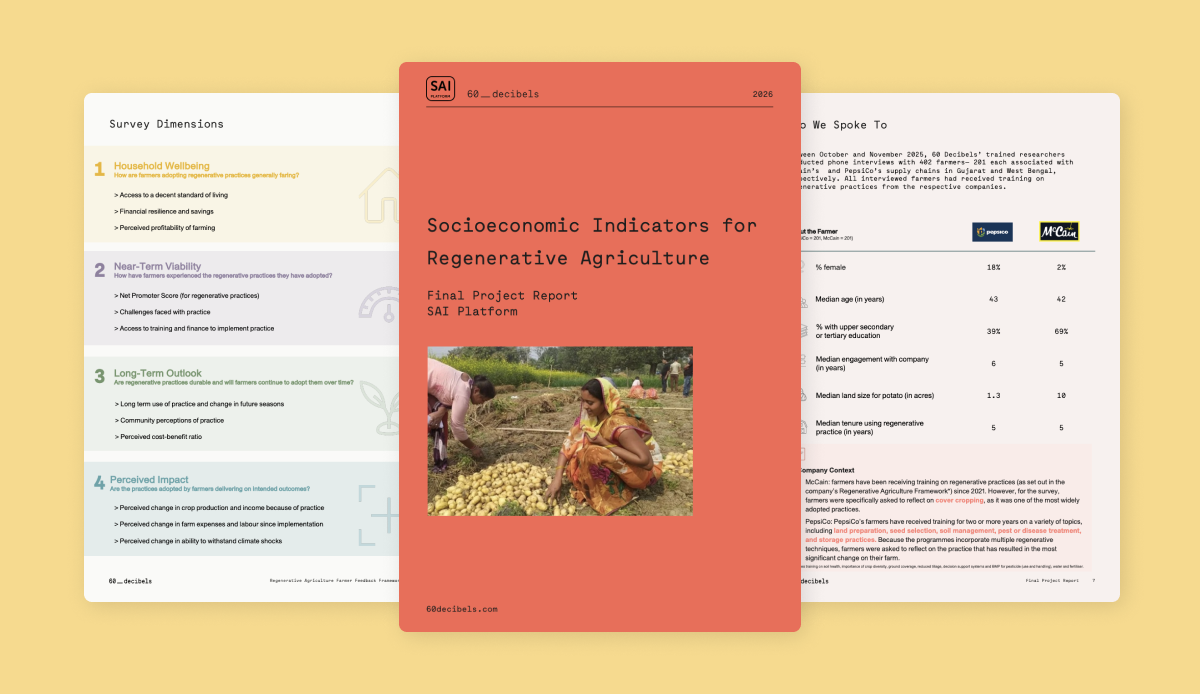
The publication marks a major milestone in the implementation of the initiative, which is supported by funding from The Rockefeller Foundation. Led by 60 Decibels in collaboration with project partners SAI Platform, McCain, and PepsiCo, the report draws on over 400 pilot consultations with smallholder farmers in India to introduce socio-economic indicators built around four key dimensions: household wellbeing, near-term viability, long-term outlook, and perceived impact. The piloted indicators examine issues such as financial resilience, profitability, access to training and finance, community perceptions, and whether farmers believe regenerative practices are improving production, income, and resilience to climate shocks.
The work reflects a broader shift in how regenerative agriculture is being measured. While environmental indicators remain vital, long-term adoption will only succeed if practices are practical, beneficial, and economically viable for the farmers implementing them. The approach aims to inform how taking account of critical aspects of farmer livelihoods will be further strengthened as part of SAI Platform’s Regenerating Together Framework, supporting companies, researchers, and agricultural programmes in designing more effective interventions, identifying barriers to adoption, and tracking progress beyond agronomic outcomes alone.
402
5 years
16
Top actionable insights
-
Farmers would recommend these practices to their peers
The practices we asked about earned an average NPS of 51, with 60% Promoters and just 9% Detractors. Promoters point to higher yields, better crop quality, improved soil fertility and less fertiliser use. Detractors want lower costs, more consistent results and more resilience to bad weather. In farming communities, adoption spreads through trust and word of mouth. That makes willingness to recommend an early read on whether a practice will spread.
-
Farmers intend to keep going, which you can see before adoption numbers move
Among McCain farmers who could estimate their plans, 51% expect to increase their use of cover cropping next season. A further 32% expect to keep it the same. 87% say the benefits outweigh the costs, and 91% say their community sees cover cropping positively. Indicators like these flag friction or risk of drop-off early, while there’s still time to respond.
-
Profitable farms can still be financially fragile
82% of PepsiCo farmers say they earned more from farming in the past 12 months than they spent. Yet only 15% manage to save every month, and 36% saved in fewer than four months or not at all. Profitability and financial resilience measure different things. Farmers with thin buffers may struggle to absorb the upfront costs of a new practice. These indicators help companies see who needs more support before they promote a new practice.
-
Gains are emerging, and so are costs
Most PepsiCo farmers report higher production (84%) and higher income (83%), though for most the change so far is slight. 36% say their farm is better able to withstand extreme weather, pointing to better soil moisture and less crop loss. At the same time, 55% report higher farm expenses and 34% say they now hire more labour. Tracking benefits and costs together shows whether farmers can realistically sustain the transition.