How Education Financing Is Changing Student Outcomes
96% of ErudiFi’s borrowers said an education loan through Bukas or Danacita was their first experience with any product like it. 97% said there was no good alternative. These numbers point to something beyond customer satisfaction: ErudiFi is reaching students who feel they would otherwise have nowhere to turn.
ErudiFi is a mission-driven education finance company working to make higher education more accessible across Southeast Asia. Through its digital platforms in the Philippines (Bukas) and Indonesia (Danacita), the company partners with universities and colleges to offer flexible tuition instalment plans and affordable education loans, helping students overcome financial barriers to tertiary education.
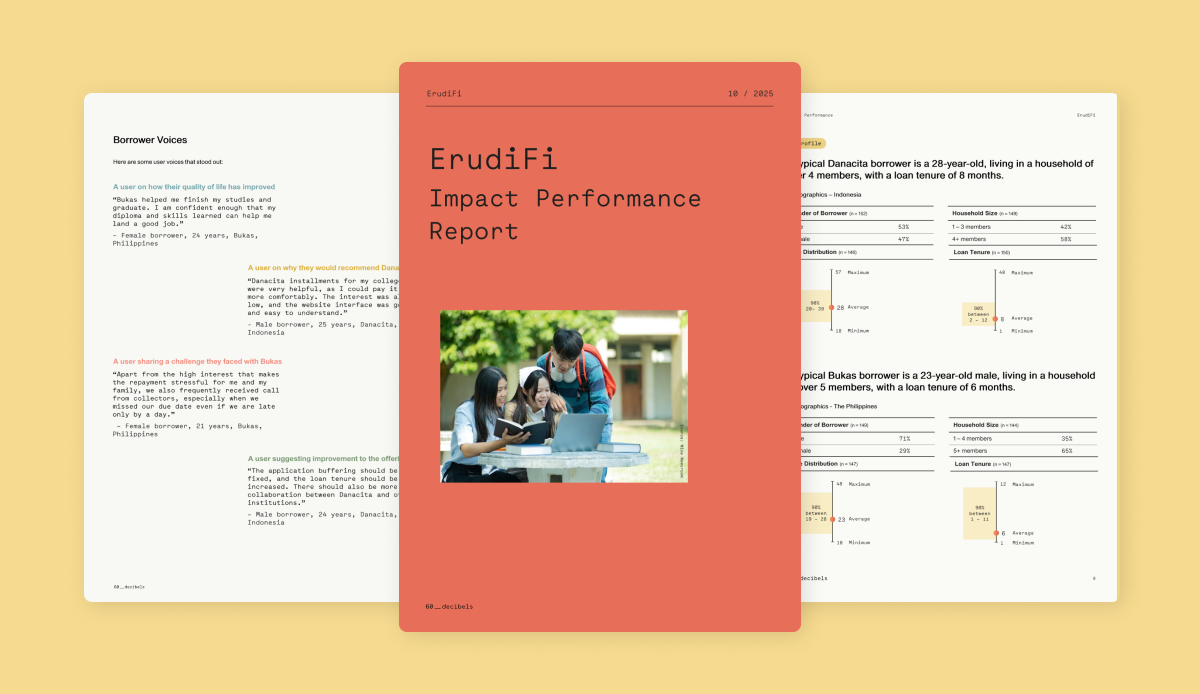
To better understand how its financing solutions are shaping students’ lives beyond access alone, ErudiFi partnered with 60 Decibels to conduct a study grounded in student voice, capturing feedback from 301 borrowers across both countries.
We spoke with Naga Tan, CEO and Co-Founder at ErudiFi, about why impact measurement matters to their mission, what stood out most from the findings, and how they’re using these insights to guide decisions across the organisation.
Why is measuring impact so central to ErudiFi’s mission?
Naga: As a student-first brand, we believe education has the power to transform lives, and that belief is at the core of why impact is one of the most important success metrics for our team.
For us, one borrower is never just one person. Each student represents families supported, aspirations unlocked, and opportunities made possible through access to affordable, quality education. Measuring impact keeps us grounded in our purpose. It reminds us why we do what we do, gives us perspective on what’s working well, and highlights where we can serve students better.
Impact puts faces to numbers, and meaning behind our products and services. When we get the mission right, the rest of the metrics tend to follow.

Why is listening directly to students so important?
Naga: ErudiFi was built with students in mind from day one. Listening to their objective, unbiased feedback isn’t just good practice; it’s essential to building a better business.
The study reinforced just how critical our role is for many students. 96% of borrowers told us this was their first time accessing a product like ours, and 97% said they could not easily find a good alternative. That tells us we’re often not just one option among many — we’re filling a real gap.
Student insights help us identify pain points while also doubling down on what truly works. We see feedback as a gift, and impact measurement as a way to honour the voices of the students we serve.
What were the most meaningful findings from the study?
Naga: One of the most powerful findings was the improvement in students’ overall quality of life. 90% of borrowers said their quality of life had improved because of the education loan.
The top three outcomes borrowers reported were education continuity, reduced financial stress, and improved career prospects. These findings underscored that education financing can reach well beyond tuition, into stability, confidence, and keeping long-term goals within reach.
We were also struck by the strength of students’ financial confidence. 96% of Bukas borrowers said their ability to manage finances had improved, and 88% reported that loan repayments were “not a problem.”
This was particularly meaningful for us because we hadn’t previously focused as much on how access to an education loan could influence financial behaviour — not just affordability. The findings suggest that access to structured, transparent financing can help students build discipline and confidence in managing money, which has implications well beyond graduation.
How did the qualitative feedback deepen your understanding of impact?
Naga: The student testimonials were incredibly valuable. They went beyond financial metrics to reflect more holistic impact — from increased confidence and motivation to the development of soft and technical skills that students see as critical for their future careers.
These stories reinforced that the impact of education financing extends far beyond tuition. It shapes how students see themselves, their prospects, and their place in the workforce. The qualitative insights helped bring real depth and humanity to the data.
How are you using the impact findings in practice?
Naga: The impact report now serves as a data-driven reference point for how we make decisions across the organisation. It has highlighted clear areas for improvement, including lowering interest rates where possible, enhancing our application flow and website experience, and improving overall customer experience.
These insights directly inform our customer experience strategy, both online and on the ground, helping us reduce friction, address pain points, and design more student-centric processes.
Just as importantly, the data gives us a benchmark to track progress over time. Impact measurement is no longer a one-off exercise for us; it’s an ongoing tool to ensure we stay accountable to our mission and continuously improve how we serve students.

This study illustrates what becomes possible when an organization treats student voice as a strategic input rather than a validation exercise. ErudiFi is tracking whether financing translates into stability, confidence, and long-term opportunity for students.
The findings point to impact that extends well beyond tuition. 90% of borrowers said their quality of life had improved, and the data suggests that structured, transparent financing may help students build financial capability that lasts beyond graduation. For ErudiFi, these insights now inform everything from interest rate decisions to application design, showing how rigorous impact measurement can drive both mission alignment and product improvement.