
60dB’s 2025 Year in Review
In 2025, we learned that some of impact investing’s most comfortable assumptions are no longer holding up, and that better data is starting to change real investment decisions.
Our Year in Review shares five lessons from direct conversations with customers and workers, as well as five shifts we think will matter most for impact investors in 2026.
Five insights from 2025
These insights shaped how we approach listening, learning, and acting on impact. Real-world lessons from voices on the ground.
-
Fewer borrowers say they understand their loan terms
Something important is shifting in microfinance. Analyzing the last four years of our MFI Index, we found that, in Africa, the share of micro-credit borrowers who strongly agree they understand their loans fell from 80% in 2022 to 63% in 2025, based on tens of thousands of borrower interviews conducted each year.
Much of that decline is tied to the shift toward digital lending. Borrowers using purely digital channels are less likely to say they fully understand their loans than those borrowing in person. The pattern is strongest among borrowers taking unplanned, emergency loans, who rely more heavily on digital channels (27% vs. 21% of planned borrowers).
The consequences are tangible. Borrowers using digital channels are twice as likely to report unexpected fees, and across our 2025 MFI Index, understanding loan terms is one of the strongest predictors of both repayment and client satisfaction. As MFIs continue to digitize, borrower comprehension is emerging as a material risk—for clients and for portfolios.
-
AI agricultural advisory is changing farming practices and outcomes
AI-powered agricultural chatbots have proliferated, but usage and quality are inconsistent. In our 2025 study with Digital Green, we examined a case where uptake was unusually strong–and why. Surveying 450 farmers in Kenya, we found that 4 out of 5 respondents had never used digital advisory before, signaling strong penetration among new users. Even more encouraging, 99% said they trusted the recommendations and 70% reported following the advice. We also measured “meaningful use” in this study, and 61% of users met that bar, more than double the national benchmark.
Farmers described concrete changes in their practices, including improved livestock diets, more accurate fertilizer use, and better pesticide application. Uptake was especially strong among women farmers, who reported higher trust, fewer challenges, and greater use.
The lesson isn’t that AI advisory automatically improves farming outcomes—it’s that when tools are localized, practical, and designed around real needs, farmers use them, and practices change.
-
Stakeholder engagement is getting real
Impact Frontiers has pushed stakeholder engagement from principle to practice. Over the past year, their work has helped turn something long treated as aspirational into something investors and enterprises can actually do, repeat, and learn from.
The 2024 Impact Reporting Norms set a shared baseline for how organizations communicate outcomes. The 2025 Stakeholder Engagement Implementation Guide goes further, laying out concrete steps for identifying relevant stakeholders, engaging them systematically, and using what they say to inform decisions.
Why this matters has always been clear: we know that the best way to understand people is to listen to them. This work is a big step toward standardizing the what, by focusing on the outcomes that matter most to those experiencing impact. And the how? Well, we might just know some folks who are experts at that…
-
New survey methods = better risk assessments
Survey method innovation might not seem exciting, but stick with us for a minute. When measuring sensitive risks like child labor in food supply chains, underreporting can lead to blind spots that affect both risk management and decision-making
In 2025, we began testing the List Experiment in work with food and agriculture companies facing child labor risk. This approach allows people to answer sensitive questions more honestly, without having to put themselves at risk by disclosing individual behaviors.
Our results with Sucden, Unilever, ETG, Mars, and others point to substantially higher levels of risk than standard approaches suggested—in some cases several times higher. We’ve since applied the same approach to other sensitive topics, including over-indebtedness and gender-based violence.
It’s early days, and we continue to refine our methods here, but we’re excited by what we’re seeing. When the cost of missing risk is high, creating safer ways for people to answer can change what you see—and what you do next.
-
We are using AI to listen faster, and to mine qualitative data for insights
In 2025, we expanded how we use AI across the impact measurement stack: accelerating data collection at scale, and applying machine learning to derive sharper insight from large volumes of qualitative data.
On the data collection side, we scaled Beto, our AI voice agent for phone interviews. Across more than ten projects in Latin America and India, we used voice AI to run full-length surveys, screen respondents, and conduct back-checks. When this works well, we can collect high-quality impact data in days rather than weeks—changing what’s feasible for diligence, portfolio monitoring, and rapid feedback loops.
In parallel, we’re using AI internally to analyze qualitative responses across both small studies and large datasets. Automated transcription, clustering, and pattern detection are shortening analysis cycles and allowing teams to surface themes and signals that would be difficult to identify manually.
We see these capabilities as essential to democratizing access to impact data and expanding whose experiences get counted. At the same time, real constraints remain: language coverage and connectivity in parts of the Global South still lag behind elsewhere, and closing those gaps will require sustained investment.
Five big moves for 2026
These are the conversations picking up momentum—the shifts shaping how capital is allocated, how success is measured, and how real outcomes are understood.
-
Investors are upgrading how they assess impact
For years, impact investors had little choice but to rely on country-level averages or indirect estimates from academic research. That constraint is starting to lift.
More investors are now moving away from proxies and toward real-world outcome data. With access to large-scale, stakeholder-level data, they can pressure-test impact claims with far more confidence—and spot both strengths and risks that averages tend to obscure.
British International Investment (BII), the UK’s development finance institution, is one investor already putting this into practice. BII uses 60dB Signal to inform diligence, shape its five-year impact strategy, and monitor outcomes across more than 1,500 portfolio companies. As Martina Castro, BII’s Head of Impact Analytics, puts it, “Signal is the Bloomberg Terminal for impact.”
Read the full story and catch up on our live session on how BII is using Signal to ask sharper questions and get clearer answers.
-
From outputs to real world outcomes (finally)
Here’s our secret dream: that outputs were always a placeholder. What matters is whether people’s lives actually change—whether households become more financially resilient, services become meaningfully usable, and wellbeing improves. If you can scale that, you’re making a dent in the universe.
In the last year, we’re seeing meaningful, global strides towards shared norms on measuring outcomes. For example, CGAP’s recent work building toward a global financial health measurement approach is helping align the sector around practical, outcome-focused metrics grounded. The World Bank’s Multi-Tier Framework is doing the same for off-grid energy, moving the conversation from “access” to “meaningful use.”
With clearer, shared definitions, outcome measurement can move from individual portfolios to something that works at scale—across institutions, and, in some cases, entire markets. In areas like financial health, that opens the door to nationally comparable metrics rather than bespoke, one-off approaches. This kind of shared infrastructure is overdue, and it’s essential if impact data is going to inform decisions at scale.
-
Innovative finance doesn’t need more ideas, it needs scale
Most people in impact investing can point to a deal they’re proud of. Far fewer can point to a financing structure that others have picked up, adapted, and reused. That gap—between isolated innovation and repeatable practice—has long limited how much innovative finance actually scales.
The Innovative Finance Initiative, launched in 2025 by trailblazer Aunnie Patton Power and her team, is explicitly focused on closing that gap. It’s a five-year, field-building effort designed to move innovative finance out of the realm of bespoke deals and into shared playbooks, practical tools, and repeatable structures.
Through themed “Missions,” practitioners are openly sharing what works across very different contexts—whether designing results-based contracts for early childhood development, blending public-philanthropic capital for climate resilience, or giving communities real ownership in infrastructure. The aim is simple: make it faster and easier to turn innovative ideas into structures that align impact and financial performance.
-
Step forward, impact family offices
Impact-first family offices are setting the pace not just through where they invest, but through what they’re willing to share. While most remain discreet, a small group is openly describing how they structure capital, take risk, and define success—and that transparency is shaping practice well beyond their own portfolios.
Singapore’s Tsao Family Office has shifted more than half of its capital toward impact and sustainability. Gunung Capital describes its impact lens as “our family’s most valuable asset.” Skagen Conscience Capital and Anthos Family Office are both moving more capital into emerging markets and patient strategies.
And then there’s the OG. Ceniarth, a longtime 60 Decibels partner, has been practicing impact-first investing for over a decade—well before the term became fashionable. The family office has been explicit about prioritizing impact over financial return, deploying patient and, at times, concessionary capital across financial inclusion, climate, and rural livelihoods—and setting an early reference point for what serious, values-led capital can look like in practice.
With family offices globally managing over $3 trillion in assets, this kind of openness matters, especially in the wake of the dismantling of USAID and a decrease in global development finance. When experienced investors share how they actually operate, they create a powerful demonstration effect–one we hope to see more family offices embrace through 2026.
-
Impact-linked incentives, hiding in plain sight
For a long time, impact-linked financing has sat in the “great idea, hard to execute” bucket. Aligning capital with outcomes sounds simple, until you try to structure and document it, and make the economics and measurement work for all sides. SAFI, developed by Roots of Impact, is starting to change that.
SAFI—the Simple Agreement for Future Impact—gives early-stage enterprises flexible capital tied to impact ambitions without locking in rigid targets upfront. As companies deliver outcomes, repayment discounts kick in, creating real incentives to focus on what matters while preserving early flexibility. Roots of Impact first tested the model on its own raise, with Delta Fund and others, and SAFI is now being used by a growing number of social enterprises.
At 60 Decibels, we’ve long believed that incentives matter a lot when it comes to achieving outcomes that genuinely improve people’s lives. That’s why, together with Roots of Impact, we’re leveraging our data to launch a SAFI-structured fund focused on uncovering and rewarding companies with hidden potential to deliver outsized impact. You guessed it: it’s called The Hidden Potential Fund.
Five Volume reads you couldn’t put down
The Volume is a curation of our favorite weird & wonderful finds, with over 12,000 fellow data geeks tuning in each month. Not yet one of them? Sign up here.
Here are the most popular Volume articles from 2025, based on your clicks.
-
Mortality: Now in technicolor!
Today’s tasty morsel of data-viz is Nathan Yau’s mesmerizing (if slightly morbid) visualization of life expectancy odds. Like a digital bingo board, each falling chip represents your probability of survival at different ages (yikes!). For the brave souls wanting to dive deeper, Yau’s companion piece, How You Will Die, offers a colorful breakdown of life’s, uh, inevitable exit strategies. If all this has you questioning how to spend your 4,000 weeks on earth, take a cue from Oliver Burkeman—a 60dB favorite (ICYMI, more on this in Sasha’s blog). His advice: to figure out how to make the most impact, “Stay on the f***ing bus!” Our unique voice, in art or in life, emerges when we persevere through the hard parts.
-
Rhino Ubers are a thing now
Somewhere in Botswana, a two-ton rhinoceros is swinging beneath a helicopter, belly-up, legs skyward, a tranquilized wrecking ball over the sprawling grasslands. Vietnam-era choppers (ironically once used by wildlife poachers) are now airlifting endangered rhinos to safety. The approach is surprisingly gentle: the inversion protects the rhinos’ spines, and their horns act like rudders, reducing in-flight spinning. Thanks to this unconventional approach, black rhino populations have surged 160% over the past 30 years. We love a wild idea that delivers big impact, and former war machines as rhino Ubers definitely fit the bill.
-
Small talk, big feels
60 Decibels’ love language is simple: ask a stranger a question and see what unfolds. That philosophy appeared in a recent article in The Pudding, and is one of the most charming data stories we’ve read all year. Hello, Stranger follows real people through 30-minute video calls with strangers. Nearly 1,700 conversations logged and visualized show something intriguing: people crave human connection, they just don’t know how to start. Participants feared rejection and awkward silences, but ended up engaging in deep conversation about anything from professional aspirations to eldercare struggles. Conversations between individuals with differing political views were as emotionally rich as those between like-minded pairs, challenging the notion that ideological divides hinder connection. This reminded us that listening isn’t just our job, it’s a tiny, radical act of connection.
-
Take my AI… Please!
Latest Gen-Z burn: calling someone “Artificially Intelligent” when they ChatGPT their way through life. Armed with this intel, you might wonder what happened when UVA professor Piers Gelly pushed his students to be maximally Artificially Intelligent. The story unfolds in What Happened When I Tried to Replace Myself with ChatGPT in My English Classroom?. It’s a twisty tale of rejoicing students, class votes on AI-versus-human essays (spoiler: ChatGPT writes better romance than you’d expect), and one big, final question: “Would you rather repeat this class with just your human professor?”
In a big W for the humans, students ultimately rebelled against the frictionless (nay, soulless) feeling of AI instruction. They wanted “the experience of being confused and struggling through it.” This finding is supported by research showing that we learn more when the work is hard: effort triggers deep processing, and skipping that struggle short-circuits brain-building. It’s like using a calculator before you’ve learned to count change. In this feel-good ending, students willingly chose the harder path. The kids are alright, folks (for now).
-
Sorry I’m late, time shrunk
If it feels like the days are flying by, that’s because they literally are. July 9, 22, and August 5 clocked in as some of the shortest days on record, each shaved down by a few milliseconds thanks to shifts in Earth’s molten core and melting glaciers changing how mass is distributed across the planet. Like a figure skater pulling in their arms to spin faster, Earth’s rotation is speeding up. If this continues, scientists may have to subtract a leap second from global timekeeping — something that’s never been done before. Since GPS, telecom networks, and financial markets all depend on atomic clocks, even tiny mismatches could disrupt satellites and transactions worldwide. And if you missed your deadline last Tuesday, you technically did have less time.
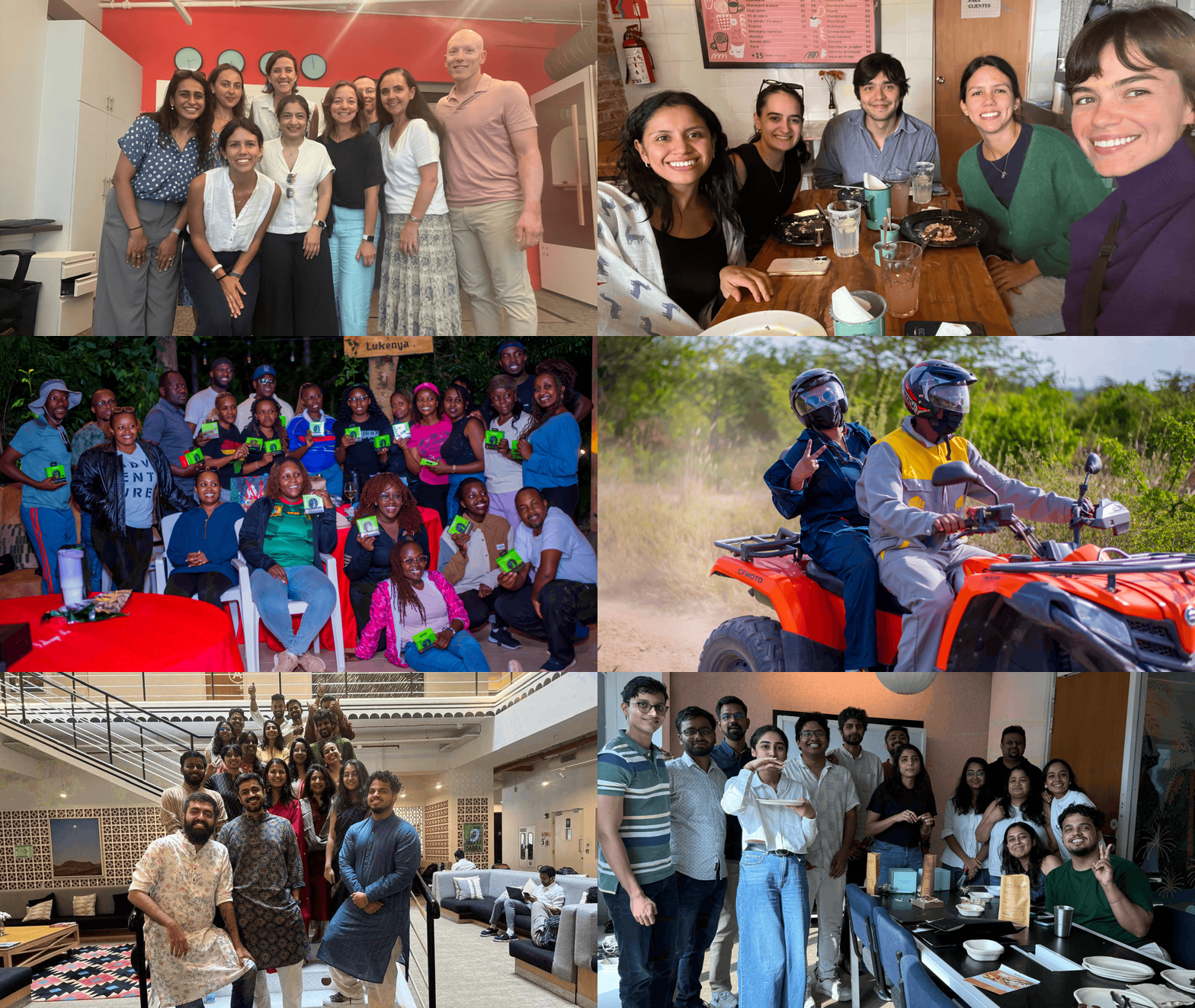
Some 60dB faces behind the data!
2025 by the numbers

141,000+

604

61
