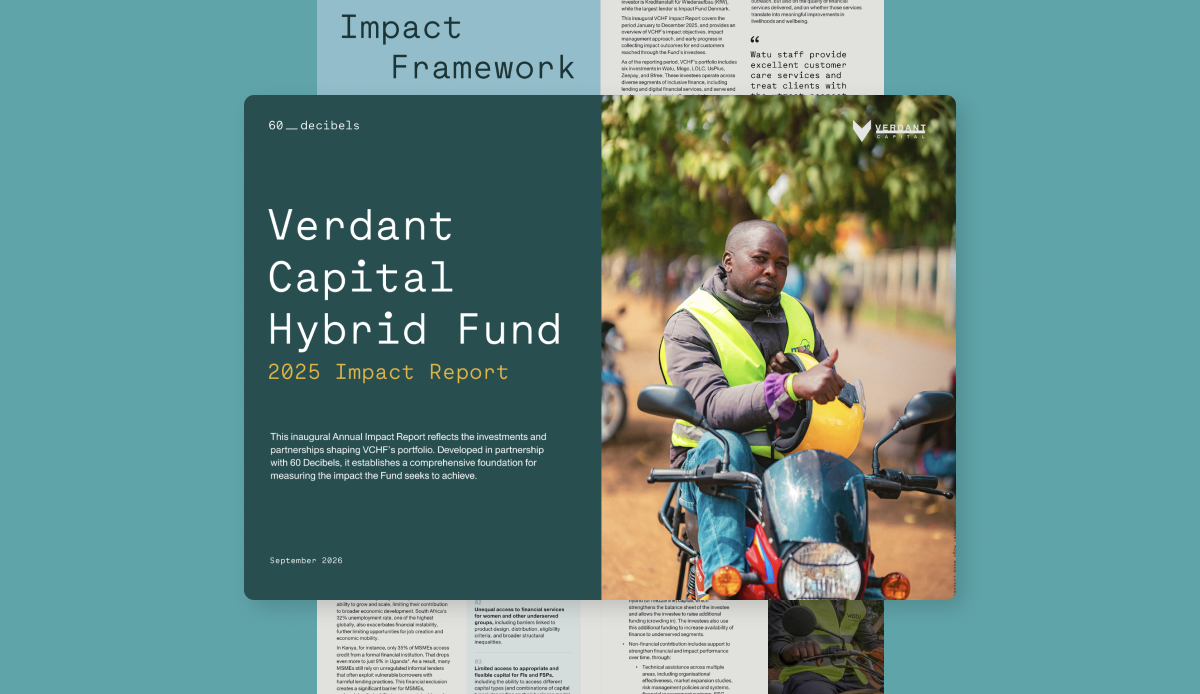
Verdant Capital Hybrid Fund: Building Customer Measurement Into a Fund From the Start
Verdant Capital Hybrid Fund (VCHF) provides hybrid capital to financial service providers across Africa so they can lend to individuals and small businesses that formal institutions tend to miss. The Fund launched in December 2021, is backed by KfW, and runs a technical assistance facility funded by BMZ. As of December 2025 it had deployed USD 39.5 million across six investees in 12 countries.
In June 2025 VCHF appointed 60 Decibels as its impact measurement and management partner. Our mandate was end-to-end: design the measurement, collect the data independently and report what it shows, including the parts that are uncomfortable.
How the Fund approached it
Verdant asked for measurement to be designed before the data collection started, so the work began with the Fund’s own documents and teams. We reviewed every investment and fund-level paper and spoke with the management, investment, finance, impact and ESG teams, then set out a Theory of Change and an impact framework aligned with the Operating Principles for Impact Management, drawing on the Impact Performance Reporting Norms, the Impact Management Platform and CGAP’s financial inclusion impact pathways.
From there came an impact thesis for each investment: how that business model contributes to the Fund’s objectives, which stakeholders it reaches, what could limit the outcomes, and which indicators to track at baseline, midline and endline.
The customer studies followed. We ran phone surveys with more than 850 customers of four investees — Watu, Mogo, LOLC (Rwanda and Zambia) and UsPlus — around 200 per study, in local languages and anonymously. Results are delivered through Signal so the team can cut them by company, segment and over time, and every metric sits against our Financial Inclusion — Lending in Africa benchmark, which covers 150 projects across 26 countries. A third of customers reporting better quality of life only means something next to a comparison group.
What the data showed
Jobs, counted from what customers said
Job creation is the Fund’s primary objective, so we built the estimate from the ground up. Customers told us whether they use the loan to generate income and how their headcount has changed, and we scaled those answers to each investee’s full loan book with a margin of error. The result: 316,601 jobs created across the four investees studied, with a further 1,066,306 supported. Watu accounts for 227,046, where 92% of boda boda borrowers use the loan to earn a living. It supports a contribution claim rather than an attribution one, and the method is published so the figure can be read for what it is.
Reach is established, depth of impact is still arriving
The portfolio is in the top quintile of our benchmark for hiring, with 48% of customers reporting more paid employees. Quality of life and business revenue sit below it, at 31% and 25%. These are baselines, taken before income gains and repeat lending have had time to show, and the investee closest to the benchmark lends shorter-term working capital while the furthest finances longer-term assets. Publishing that gap at baseline is what makes the next round of data worth collecting.
Customer experience splits the portfolio, and points at what to fix
UsPlus, which finances established SMEs against their invoices, records an NPS of 94, the highest we have seen in this benchmark. The four lenders serving micro-entrepreneurs sit below it, and the gap follows challenge rates: between 28% and 42% of their customers report a problem with the loan or the provider, and satisfaction is lowest where challenges are highest. For the Fund, that turns a soft finding into an addressable lever, through technical assistance aimed at challenge resolution and client protection.
Technical assistance, measured alongside the capital
The Fund runs 24 technical assistance projects with its investees. We survey the investee staff who ran them, so the Fund can see whether the objectives were met, whether the change can reasonably be attributed to the support, and whether it will last. Those findings are triangulated with the customer data, which is how a fund learns whether its non-financial support reaches customers at all.
Where this goes next
Baselines are the start of a measurement system rather than the end of a reporting exercise. Midline and endline studies will show whether depth of impact arrives and whether customer experience improves. Once five investee studies are complete, VCHF will have portfolio-level benchmarks of its own, so each new investment can be read against the Fund’s own track record as well as the market.